
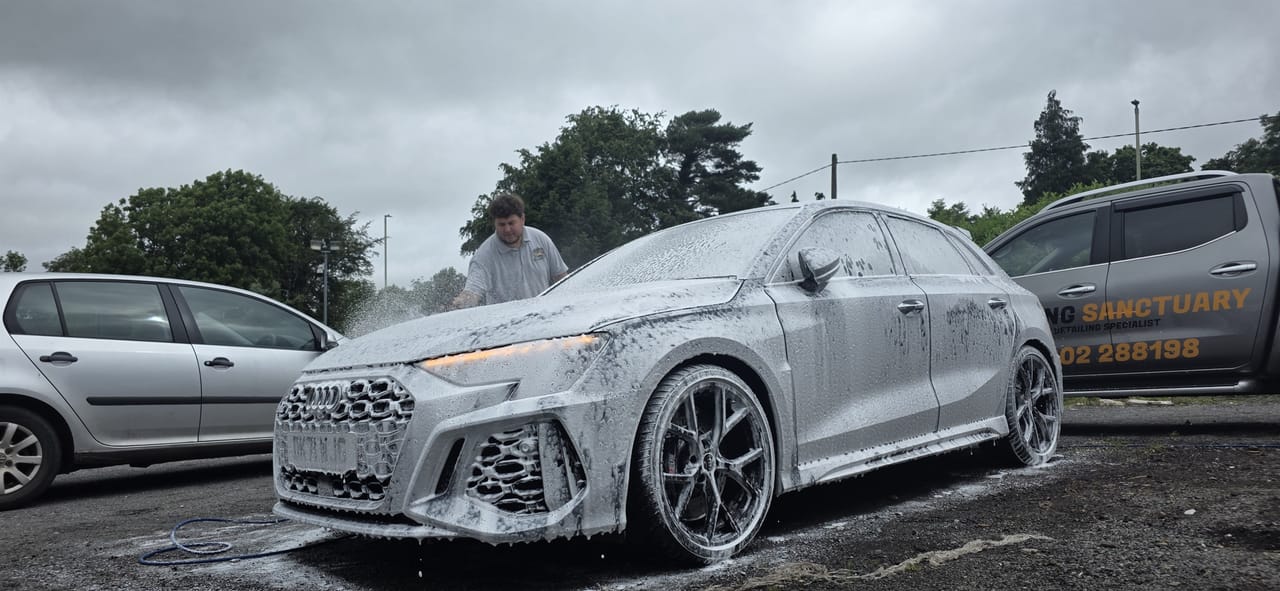
Overspray Removal in Wolverhampton
Thousands of tiny paint specks across the bonnet, the roof and the windows, and the paint feels like sandpaper when it looks clean. That's overspray. It's drifted onto the car from somebody else's spray gun and dried where it landed. We take it off by hand - a safe wash, a full chemical decontamination, then a clay bar over every painted panel and the glass.
The £165 buys the wash, the full decontamination and the clay bar over the whole car, and it is a complete job on its own. Where the overspray has cured hard into the lacquer, clay alone will not lift it and the affected panels need machine polishing as well. That is quoted on the day before any polishing starts and adds up to about £160 on a small car - so up to around £325 in total on a small car. Bigger cars are more, because there is more paint. The £165 is for a small car; each vehicle size step adds 7%.

What overspray actually is
Overspray is paint that never reached what it was aimed at. A spray gun, an aerosol or a line-marking machine throws a fine mist, the wind takes part of it, and it settles on whatever is downwind. On a car it dries where it lands as thousands of separate specks sitting on top of the clear coat.
You usually see it before you can name it. It shows worst on light colours and in direct sun, and it collects on the panels facing the sky - the bonnet, the roof, the boot lid, the top of the wings - and down whichever side faced the source. It gets on the glass as well, which is often the first place people notice it.
There's a test you can do yourself in two minutes. Wash the car and dry it properly. Then put a thin sandwich bag over your hand and slide your fingers lightly across the paint. Clean paint feels like glass. If it feels gritty when it looks clean, something is bonded to the surface, and if you can see the specks and they're all the same colour, it's very likely overspray.
- Same-colour specks, spread evenly across whole panels
- On the glass as well as the paint
- Worst on the panels that faced the sky or faced the source
Where it comes from, in rough order of how often we see it: a decorator or a housebuilder spraying masonry or trade paint nearby, a fence or a shed being sprayed a few gardens away, roadworks with a line-marking machine, and industrial or bodyshop work.
It might not be overspray
Rough paint has several causes and they need different treatment. It's worth knowing which one you've got before you pay anybody.
Iron fallout and rail dust. Tiny hot metal particles from brakes and railway lines that land and rust into the lacquer. Shows as orange or brown specks, usually worst on the lower half of the car and on white paint. Comes off with a chemical fallout remover.
Brake dust. Same family, concentrated around the wheels and lower panels.
Tar. Black, sticky, mostly along the sills and behind the arches. Comes off with a tar solvent.
Tree sap. Clear or amber blobs. Fresh sap comes off. Sap that's been baked on through a summer can etch a ring into the lacquer, and then it's a polishing job.
Concrete, cement and render splatter. Grey or white, often slightly raised and rough. This is alkaline and it needs a dedicated acidic dissolver, not a clay bar. If it has been on long enough to etch the lacquer it may not come out at all.
Overspray. Thousands of same-colour specks, evenly spread across whole panels rather than clustered, and on the glass as well as the paint.
The good news is that the job below deals with most of these anyway. The wash and the chemical decontamination remove iron fallout, rail dust, brake dust, tar and fresh sap before the clay bar goes anywhere near the paint. Concrete splatter, etched sap and etched bird lime are the exceptions, and we'll say so when we see the car.
One thing worth knowing, because a lot of detailing marketing blurs it: the purple spray isn't removing the overspray. An iron fallout remover turns purple because it's reacting with iron, and iron only. It won't dissolve paint. It's there to take the fallout off so the clay bar has less to pick up. The clay is what lifts the overspray.
Water based or oil based - why it changes the job
What the paint was makes a real difference, and it isn't quite the simple "water based easy, oil based hard" you'll read elsewhere. What matters is how the paint hardened.
Emulsion, masonry paint and trade acrylic dry by the water evaporating out of them. They stay thermoplastic, which means the dried film sits on top of the clear coat rather than becoming part of it. A clay bar shears that off. This is the common one - a decorator, a fence, a garden wall.
Two-pack paint and epoxy are different. They cure by a chemical reaction with a hardener, and once that reaction has happened the film is thermoset. It won't re-dissolve, and the clay tends to skate over it rather than grip it. This is bodyshop and industrial paint, and it's the case that moves the price.
Two things matter at least as much as which paint it was. How long it's been there: fresh overspray comes off far more easily than overspray that's sat through a summer, because it hardens and UV keeps working on it. How heavy it is: a light dusting over one side is a different job from a car that was parked next to the work for three days.
The most reliable clue is where it came from. If a decorator was working nearby and the specks are white, magnolia, grey or off-white, it's almost certainly trade paint and it'll clay off. If it came from a bodyshop or an industrial site, or the specks are an automotive colour or a metallic, expect it to be the harder case.
We work out which one it is on the day, on the car, after it's washed. You can't reliably tell from a photo and neither can we - a photo tells us the colour, the coverage and roughly how long it's been there, which is enough to give you an honest steer, but not enough to promise a price.
Please don't try a solvent on it yourself. A lot of the advice online names solvents that will damage a modern clear coat, and once the lacquer is marked, no amount of claying fixes it.

Nothing touches the paint dry
Overspray sits on top of the clear coat, and so does everything else the car has collected. Washing a contaminated panel before the loose grit is off is how you put swirl marks in while trying to take specks out.
So it is foam first and left to dwell, then a rinse, then the chemical decontamination, and only then does anything make contact. By the time the clay comes out, the only thing left on the paint is the overspray itself.
- Snow foam and a rinse before any contact at all
- Iron fallout and tar chemically dissolved, not rubbed off
- Fresh clay and plenty of lubricant, so the clay is not dragging grit
What the job involves
Wash it first
Snow foam pre-wash, then a two-bucket contact wash and a dry, so nothing gritty is still sitting on the paint when we start. Claying a dirty car drags the dirt across the lacquer.
Chemical decontamination
An iron fallout remover and a tar solvent take off everything that will come off chemically. The less the clay bar has to pick up, the less it marks the paint.
The clay bar
A lubricated clay bar over every painted panel and the glass, section by section, with the bar folded to a clean face whenever it loads up. A dropped clay bar goes in the bin - it picks up grit off the driveway and turns into sandpaper.
Rinse, protect and a straight answer
A final rinse, a dry, and a protective layer back on the paint, because the decontamination takes off whatever wax or sealant was there. Then the paint is checked panel by panel and you get a straight answer on what is left.
We clay the whole car rather than just the panels you can see specks on. Overspray drifts, so it's almost never confined to where it's obvious - and a car that's smooth on the bonnet and gritty on the doors just looks half done. That's also why the price is for the car and not per panel: you shouldn't have to count panels to find out what this costs. Around four hours on a small car, a bit longer on something large.
What it costs, and when polishing is needed
From £165 for a small car. Each vehicle size step adds 7%, the same as everything else we do. That covers the wash, the full chemical decontamination and the clay bar over the whole car. A 25% deposit holds the date and comes off the final bill, so on a small car that's £42 to book.
When it costs more. Where the overspray has cured hard into the lacquer, the clay won't lift it, and claying heavily enough to try leaves the paint dull. Both of those are fixed the same way - a machine polish on the affected panels. That's usually the ones that faced the sky or faced the source, not the whole car.
On a small car that adds up to about £160, so up to around £325 in total on a small car. Bigger cars are more, because there's more paint.
Three things we'll always do:
- We quote the polishing before we start it, not after. You see the car washed and clayed, we tell you what's left and what it'll cost, and you decide. Nothing extra happens without your say-so.
- The £165 work happens either way. It's a complete job on its own - the car comes back clean, decontaminated and smooth, and you're never paying for something that has to be redone.
- We'll tell you when polishing isn't worth it. If what's left is faint and only visible in direct sun at the right angle, we'll say that rather than sell you an afternoon of machine work.
Why the polish is a real cost and not an upsell. Machine polishing removes a small amount of clear coat, permanently, and clear coat doesn't grow back. A factory clear coat is usually only around 30 to 50 microns thick. We take paint depth readings before any machine work and stop if the paint is too thin to take it. That's also why we don't polish a car that doesn't need it. If the paint underneath needs putting right as well, that's a paint correction rather than an overspray job, and it's priced as one.
One question people ask here: why does the £135 Deep Clean not include a clay bar, when this does? Because they're solving different problems. The Deep Clean's decontamination is chemical - iron fallout and tar - which is what's actually on most cars, and it's inside-and-out. Clay is the mechanical step for what the chemicals leave behind, and it's included where it earns its place: overspray jobs, paint corrections and ceramic coatings. This job is exterior only and the clay is the whole point of it.
What we can and can't promise
What usually comes off completely. Light to medium water-based overspray on paint and glass. Glass is the most forgiving surface of the lot and normally comes back fully.
What usually needs polishing as well. Overspray that's been on for months, heavy coverage, and two-pack or industrial paint. See the section above - we quote it before we touch it.
What sometimes won't come off at all. Being straight about this is more useful than a promise we can't keep.
- Overspray that's etched. If a fingernail catches a ring or a crater rather than a raised speck, the paint underneath has been attacked, not just landed on. Etching doesn't always polish out, and where it's gone through the clear coat it can't.
- Concrete, cement and render splatter that's etched the lacquer.
- Thick blobs of road marking paint. Clay takes fine specks off flat paint. It won't take off a blob, and a blob that thick can pull clear coat with it. If a test patch marks the lacquer we stop and tell you, and that's a bodyshop conversation rather than ours.
- Textured black trim, rubber window and door seals, and arch liners. A clay bar tears on textured surfaces and embeds itself in the grain, so it doesn't go near them. We work those by hand with a solvent where it's safe to, and anything that won't come off safely we leave and point out to you rather than risk the trim.
- Matte and satin finishes and vinyl wraps. No machine polishing on matte paint, ever.
- Failing or peeling clear coat, and very recently resprayed paint. Both need leaving alone.
We don't offer wet sanding. If a car genuinely needs that to get the overspray off, we'll tell you rather than sell you something that won't fix it.
The decontamination and the clay take off whatever wax or sealant was on the paint, so we put protection back on as part of the job. If your car has a ceramic coating, the clay won't remove it - but if the car needs machine polishing, the polish will, and we'll tell you that before we start so you can decide.

Who pays for it
If somebody else's work put the paint on your car, the claim normally goes against their public liability insurance rather than your motor policy. That's worth knowing before you do anything else.
Photograph it and report it before the car is cleaned. Once the overspray is off, the evidence is off with it. Get pictures in daylight, note the date and where the car was parked, and tell whoever was doing the work - or the contractor, or the highway authority if it was roadworks - before you book anything.
Think twice before claiming on your own policy. You pay your excess first, and for a job between £165 and around £325 on a small car - more on anything larger - the excess is often more than the work costs. Your no-claims discount is normally reinstated once your insurer recovers what it paid from whoever was responsible, but if it can't recover, the discount can be affected.
Beyond that, we're detailers, not insurance advisers. Whether a claim succeeds is between you, the other party and the insurers, and we can't advise you on it.
Where the work happens
We come to you, the same as everything else we do - your home or your workplace, anywhere within about 30 miles of Wolverhampton. There's no call-out fee. It runs the same way as a mobile valet, just with the clay bar as the whole point of the visit.
What we need is access to the car on a reasonably flat surface with room to work around it. We bring our own deionised water and power, so you don't need to supply anything.
Weather matters more on this job than on most. Claying needs the panel wet with lubricant, and it's slower and less pleasant in heavy rain or in direct sun on a hot day. We'll still come - we work under a gazebo when we need to - but if the forecast is bad enough to affect the quality we'll ring you and move it rather than do a worse job.
Overspray work often goes alongside a paint correction when the paint underneath needs putting right too, and it's worth doing before any ceramic coating goes on - a coating over overspray seals it in.
What people add to it
Paint Correction
Where the overspray has cured hard, or the paint underneath is swirled, Stage 1 machine cutting takes out up to 75% of the defects.
Ceramic Coatings
Worth doing after the overspray is off, never before. The wash, decontamination and clay are already inside every coating package.
Mobile Valeting
Overspray removal is exterior only. Add a Full Valet and the inside gets done in the same visit rather than a second trip.
Available across Wolverhampton, Walsall, Dudley, Telford, Cannock, Birmingham and the rest of our 30-mile radius.
Paint we have decontaminated
Not every one of these came in covered in overspray - most are cars in for a deep decontamination, a correction or a coating. What they share is the part that matters here: paint that felt rough going in and smooth coming out.


Questions people ask
What is overspray?
Paint that drifted through the air from somewhere else and dried on your car. It sits on top of the clear coat as thousands of tiny same-colour specks, and it makes the paint feel gritty when it looks clean. It usually comes from decorating, fencing, roadworks or bodyshop work nearby.
Will a clay bar remove overspray?
Usually, yes - that is the main tool for the job. A lubricated clay bar shears off anything standing proud of the clear coat, which is exactly what dried overspray is. Where it has cured hard into the lacquer, or it has been on for months, the clay will not lift it and the panels need machine polishing as well. We tell you which one yours is after the car is washed, before any extra work starts.
What is the difference between water-based and oil-based overspray?
Emulsion and trade paint dry by evaporation and stay on top of the clear coat, so they clay off. Two-pack and epoxy paint cure by a chemical reaction and effectively set hard, so clay tends to skate over them and they usually need machine polishing. How long it has been there matters just as much - old overspray of any kind is harder than fresh.
How much does overspray removal cost?
From £165 for a small car, which covers a safe wash, a full chemical decontamination and a clay bar over the whole car. Each vehicle size step adds 7%. Where machine polishing is needed on top, that is quoted on the day before we start it - on a small car that takes it to around £325 in total. Bigger cars are more, because there is more paint.
Does overspray damage the paint?
Ordinary domestic overspray sits on top of the clear coat rather than eating into it, so on most cars it is removable rather than permanent. What does happen is that it hardens over time and UV keeps working on it, so it gets harder and more expensive to take off the longer it is left. Overspray that has actually etched the lacquer - where you can feel a ring or a crater rather than a raised speck - cannot always be polished out.
Can you clay the whole car, including the trim?
Every painted panel and the glass, yes. Clay does not go on textured plastic trim, rubber window and door seals or arch liners - it tears on textured surfaces and embeds itself in the grain. Those we do by hand with a solvent where it is safe to, and anything that will not come off safely we leave and point out rather than damage the trim.
Why does the £135 Deep Clean not include a clay bar?
The Deep Clean's decontamination is chemical - iron fallout and tar - which is what is actually on most cars, and it covers inside and out. Clay is the mechanical step for what the chemicals leave behind, and it is included where it earns its place: overspray, paint corrections and ceramic coatings. This job is exterior only and the clay bar is the whole point of it.
Do I need to do anything before you arrive?
If you have not already, photograph the car before we clean it - once the overspray is off, so is the evidence. Other than that, just leave it parked where we can get around it. Please do not try a solvent on it yourself.
Tell us what has landed on it
Send a photo of the worst panel, taken in daylight, and tell us roughly when it happened and what was being sprayed nearby. We'll tell you honestly whether it's a clay job or whether it's going to need polishing as well, and what that means for the price, before you commit to anything.