
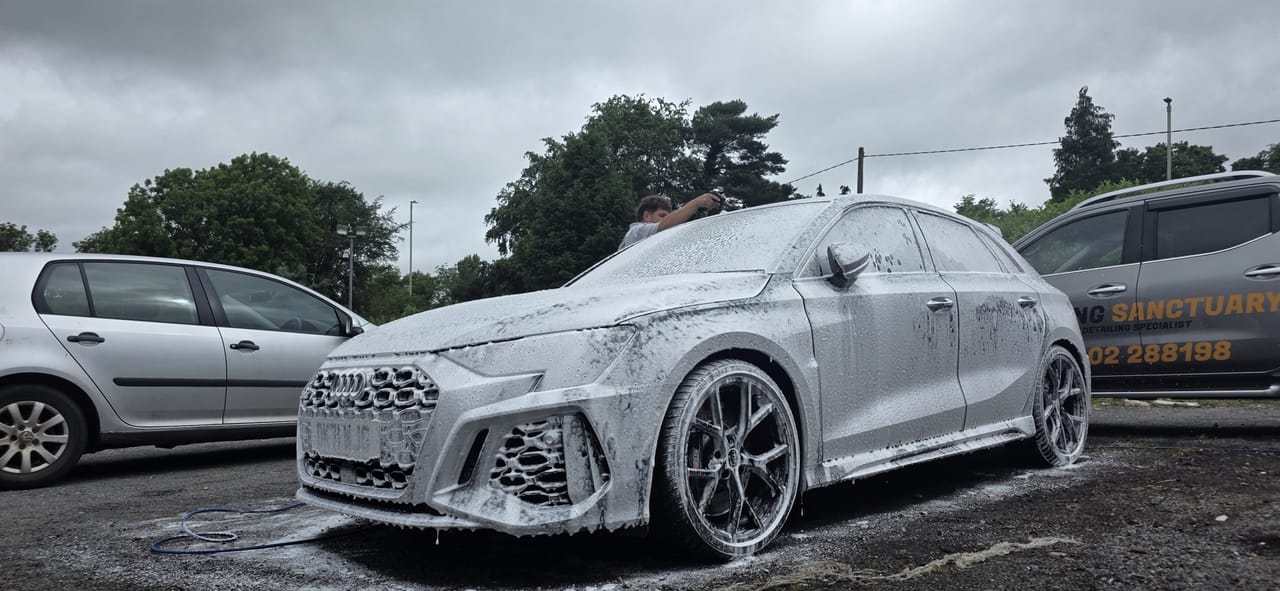
Why Deionised Water Matters for a Spot-Free Finish
Those pale rings on a dark car after a wash aren't dirt you missed. They're what was dissolved in the water, left behind when it evaporated. Here's why it matters and what we do about it.
By Patrick · 10 September 2026
What a water spot actually is
Tap water carries dissolved minerals - mostly calcium and magnesium, measured as "total dissolved solids". When a drop of it dries on paint, the water evaporates and the minerals stay behind as a ring. On glass it's a chalky mark; on dark paint it's a pale spot. Rinse a black car in the sun with a hosepipe and you can watch it happen.
The West Midlands sits on limestone-influenced supply and much of the region has hard water, which is why the spotting here is worse than in a soft-water area. The tap water in Wolverhampton is fine to drink. It's a poor thing to dry on a car.
Why it's more than cosmetic
A fresh spot wipes off. Left in the sun, the minerals bond and the alkaline residue starts to etch the clear coat - a shallow crater in the paint that a wash won't shift and only a machine polish will remove. On a ceramic-coated car, heavy spotting can etch into the coating itself. So the choice of water isn't about the finish on the day; it's about whether every wash is slowly damaging the paint.
The usual fix and why it fails
The standard answer is to dry the car quickly with towels before the spots form. It works, sort of, on a small car in the shade. On a black SUV in July it's a race you lose, and every pass of the towel over a not-quite-clean panel is dragging grit across the paint - which is where a lot of swirl marks come from. Drying isn't the solution. Not leaving anything behind is.
Deionised water: nothing dissolved, nothing left
Deionised water has had the dissolved minerals removed - it measures at zero total dissolved solids. When it dries, there is nothing in it to leave behind. A panel rinsed with deionised water can be left to air-dry in full sun and comes up clean. No spots, no streaks, no towel work, no dragging.
We source ours from Spotless Water, which is filtered to zero TDS, and we carry it to every job in the van. That has a second benefit that customers notice more than the first: we don't need your outside tap. All we need is a socket.
Where it matters most
Dark paint, where every spot shows. Glass, where mineral haze is what makes a screen smear in the rain. Ceramic-coated cars, where the coating is the thing you're protecting. And matte finishes, which can't be polished to remove etching at all - on a matte car, the water you rinse with is the whole game.
What you can do at home
If you wash your own car: wash in the shade or early morning, work one panel at a time, and rinse with a filter if you can - an inline deioniser for a hosepipe costs from about £50 and the resin lasts a season on a normal car. If you can't, dry immediately with a clean drying towel and accept that a hot day is a hot day. Or book a maintenance visit and let us bring the water.
Deionised, distilled and filtered - what's the difference?
Filtered water has had particles and some chlorine removed; the dissolved minerals that cause spotting are still there. Distilled water has been boiled and condensed, which leaves the minerals behind - effectively pure, but slow and expensive to make in the volumes a car wash uses. Deionised water is passed through resin beds that swap the calcium and magnesium ions for hydrogen and hydroxide, which recombine as water. The result is the same as distilled for our purposes - zero total dissolved solids - but produced fast and by the hundred litres. Spotless Water makes it at that scale, which is why we source from them rather than running a small home unit that's exhausted after two cars.
How much water a wash uses, and why we carry it
A proper safe wash - pre-rinse, snow foam, contact wash, rinse, and a final deionised rinse - uses somewhere between 60 and 120 litres on a standard car, more on a large SUV. That's why "we bring our own water" matters beyond the spotting: it means we don't need an outside tap, which opens up terraced streets, flats with a socket by the door, and workplace car parks. The van carries a tank filled with deionised water for the day. All we need at your address is an outside socket and space to work around the car with the doors open.
A test you can do at home
Fill a glass from the outside tap and let a splash of it dry on a dark plate in the sun. The ring it leaves is what every hosepipe rinse leaves on your paint. Do the same with a splash of deionised water - a bottle from a motor factor is a couple of pounds - and there's nothing. That's the whole argument in two minutes, and it's why we don't rinse a car with anything else.

Talk to us about your car
Send a photo, the car and your postcode. You'll get an honest recommendation and a fixed price.